Many GrowthBar users now search for replacements because the tool's pricing and content depth no longer match their needs. They want faster first drafts and lower monthly costs without losing SEO rankings. The decision often comes down to how much each platform automates versus how much it still requires manual editing.
By the end of this article you will know exactly which seven tools to compare, what concrete features separate Autoblogging.ai from the rest, and the single checklist you can use to pick the right option for your workflow.
What to Look For in GrowthBar Alternatives
First sentence: GrowthBar alternatives should deliver complete workflows covering keyword research, SERP analysis, content generation, and on-page optimization without forcing multiple tool subscriptions.
Strong platforms give users multiple AI generation modes. This flexibility lets teams switch between blog posts, meta descriptions, product descriptions, and social snippets inside one dashboard.
The best GrowthBar alternatives publish a clear monthly article limit. Users avoid surprise caps when scaling SEO content production across dozens of keywords.
Integration count matters for teams already using analytics or project tools. Look for direct connections to Google Search Console, WordPress, Shopify, and similar platforms that reduce manual copy paste work.
Language coverage beyond English expands reach for international campaigns. Native support for Spanish, French, German, and additional languages removes the need for separate translation services.
Credit rollover policies protect against unused plan balance. Some GrowthBar alternatives carry forward credits each month while others reset on the billing date.
Weekly feature releases keep pace with algorithm updates and new AI models. Quarterly updates can leave users waiting months for critical improvements in keyword clustering or SERP tracking.
Compare each criterion against your specific workflow needs. This approach identifies the right SEO platform before switching from GrowthBar.
1. Autoblogging.ai - Best Overall
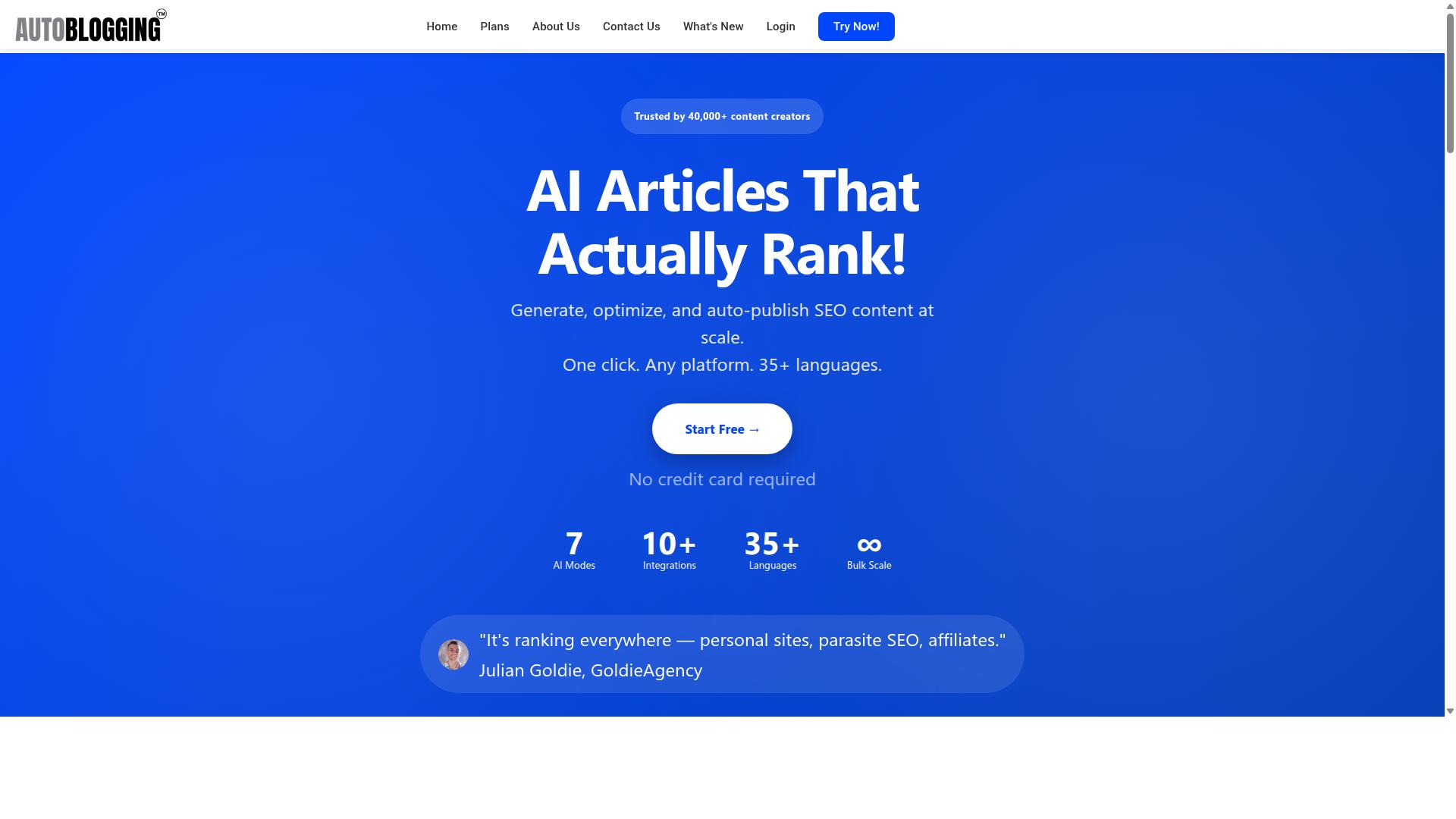
Autoblogging.ai ranks first because it combines 10 AI modes, 35+ language support, and 1M+ articles generated into a single platform used by 40,000+ creators.
This SEO platform stands out among GrowthBar alternatives because it delivers specialized modes for different content needs. Creators can choose the right workflow instead of forcing every project into one generic approach.
The system includes WordPress integration, multi-platform publishing, and Content Repurposer tools. These features help users move from idea to live content without switching between separate SEO tools.
Weekly feature releases keep the platform current with evolving search algorithms. This regular improvement cycle matters when ranking factors change quickly across search engines.
Key Features and Pricing
Autoblogging.ai offers six monthly plans from $19 Starter (40 credits) to $999 Enterprise (5,000 credits) with annual discounts and credit rollover.
Quick Mode works as the free tier for simple article generation. Bloggers who need occasional posts can start here without any upfront cost.
Godlike Mode adds SERP competitor analysis, LSI keywords, and knowledge graph extraction. Agencies handling competitive niches often select this tier for deeper content optimization.
Bulk Generation supports up to 500 articles through CSV upload. Content teams working on large sites find this option useful for scaling output across multiple topics at once.
Plans align with typical monthly article needs for different users. Freelancers often choose Starter or mid-tier options while agencies scale to higher credit volumes as client work grows.
2. Byword
Byword focuses on large-scale publishing with AI-generated articles but provides fewer generation modes and integration options than platforms offering 10+ modes.
The tool emphasizes bulk generation stability for SEO teams and agencies. Users can create over 1,000 articles in a single run with built-in research and image generation included.
Publishing cadence depends on plan limits. The service supports programmatic SEO operations where teams require consistent output across many pages.
Byword offers two main pricing tiers. The $99/month plan covers 25 articles while the $299/month plan includes 80 articles.
Typical word-count limits vary by subscription. Higher tiers allow greater volume for agencies managing serious SEO campaigns at scale.
Content teams often choose Byword when they need reliable bulk creation rather than extensive customization. The platform prioritizes volume over multiple generation modes and third-party connections.
Word-count restrictions still apply even at higher tiers. Teams running large SEO operations benefit from the stability when producing hundreds of optimized pages.
3. Surfer SEO

Surfer SEO specializes in content scoring and SERP competitor analysis but requires separate tools for bulk AI article generation.
The platform focuses on on-page optimization through its detailed content editor. Users see real-time feedback on how well their text matches top-ranking pages for the target keyword.
Keyword difficulty scoring helps writers decide which terms deserve immediate attention versus longer-term efforts. The system pulls data directly from search results to assign these scores.
Heading recommendations appear inside the editor as you write. These suggestions show which subtopics top competitors cover and where gaps exist in your current outline.
A typical workflow starts with entering the primary keyword. The tool then analyzes current search results and generates a content score based on that data.
Next, writers review the editor's recommendations for headings, word count, and semantic terms. Each adjustment updates the score so progress stays visible.
Users then draft content while following these guidelines. The system compares the live text against the benchmark set by ranking pages.
Once the score reaches a high level, the article is ready for publishing. Professional SEOs and agencies often rely on this process for client-ready reports.
4. Frase
Frase provides AI-assisted content briefs and outlines but limits bulk generation volume compared to platforms supporting 500-article batches. The platform excels at SERP research and brief building for writers and content managers. Users pay $15 per month for four articles or $45 per month for thirty articles.
Research features help users analyze search results and extract relevant questions quickly. Frase pulls data from the top ranking pages to identify common topics and subheadings. This approach supports strong brief creation without requiring extensive manual effort.
Question extraction works by scanning existing search pages for frequently asked queries. The system organizes these questions into categories that writers can address directly. Search intent becomes clearer when these questions align with user needs.
Content briefs created in Frase include suggested headings, word counts, and key topics. Writers receive structured outlines that reduce time spent on initial planning. The tool focuses on the research phase rather than large-scale production tasks.
Keyword data in Frase remains less detailed than some competing options. The AI writing component produces variable results depending on the topic complexity. Frase serves best when teams need focused research support before content creation begins.
5. NeuronWriter

NeuronWriter emphasizes TF-IDF and semantic analysis for content optimization yet offers fewer language options than platforms covering 35+ languages.
The platform uses TF-IDF scoring to compare your draft against top ranking pages. This approach highlights terms that appear frequently in strong results but remain absent from your text.
Users receive a clear breakdown of word frequency, keyword placement, and overall content structure. The system flags gaps early so writers can adjust before publishing.
NeuronWriter includes a built-in content editor that shows real time suggestions. Writers can edit directly within the tool while monitoring how changes affect their scores.
The editor displays term recommendations alongside context notes. This setup helps maintain natural flow without forcing awkward keyword placement.
Keyword suggestions draw from semantic analysis of top performing articles. The platform groups related phrases and identifies opportunities that match current search patterns.
Solopreneurs and niche site owners often select this tool when seeking semantic SEO features at accessible pricing. Plans start at EUR19 per month and reach EUR37 monthly for expanded capacity.
AI credits remain limited on each tier, which encourages focused usage. The interface presents data in a straightforward format rather than polished visuals.
6. Clearscope

Clearscope focuses on readability and content grading metrics suitable for enterprise teams but lacks bulk AI generation features. The platform emphasizes precise keyword research and content scoring for teams that need detailed optimization guidance. Content grading system evaluates text against search intent and semantic relevance before publication.
Users receive scores that highlight gaps in keyword coverage and structure. This approach helps writers refine drafts without switching between multiple platforms. Google Docs integration allows seamless access to scores during the writing process.
Editorial teams benefit from real time feedback on sentence complexity and term usage. The system supports high volume publishers who prioritize quality over speed. Keyword suggestions remain a core strength for organizations with substantial content budgets.
Clearscope delivers strong performance for enterprise content teams seeking precision. However, many users also explore other GrowthBar alternatives that combine optimization with faster content creation. Teams should compare available SEO tools based on their specific workflow needs and team size.
7. Scalenut

Scalenut combines keyword clustering with AI writing but caps monthly article output below levels needed for high-volume affiliate or parasite SEO sites.
Users can group related terms into topic clusters before they start drafting. This approach helps establish topical authority across related search queries.
The platform generates full articles once the clusters are ready. Writers receive a structured outline to follow during the creation process.
Content marketers often choose Scalenut when they want one SEO platform to manage both keyword research and drafting. The tool supports on-page SEO recommendations that align with current ranking factors.
Teams handle content briefs and semantic SEO tasks within the same workspace. They can review search intent signals before finalizing headings or meta descriptions.
Some users note that AI content can require more editing for soul. The interface offers many options for content scoring and readability checks.
How to Choose the Right Option
First sentence: Match platform capabilities to your content volume, language needs, and budget by comparing credit allowances, generation modes, and integration counts.
Bloggers and affiliate marketers need a clear process before switching from GrowthBar. The right decision framework prevents wasted spend and keeps your content pipeline moving without surprises.
Calculate your monthly article target first. Count how many pieces you publish each month and check each GrowthBar alternative against that number. This single step shows whether the credit system fits your actual workflow.
Next, check language and integration requirements. Review whether the platform supports your primary language and connects to the tools you already use. Marketing agencies often need multiple integrations while solo bloggers may only require basic CMS connections.
Compare credit rollover policies after that. Some platforms reset credits monthly while others allow unused credits to carry forward. This detail matters when your publishing schedule varies from month to month.
Verify support hours in the final step. Response times and availability differ across GrowthBar alternatives. Agencies running client sites need reliable help during business hours while bloggers may accept slower replies.
Autoblogging.ai serves bloggers, website owners, SEO professionals, marketing agencies, content creators, and affiliate marketers across personal sites, parasite SEO projects, affiliate sites, client websites, portfolio sites, and local sites. Apply the four-step framework above to see which GrowthBar alternative aligns with your specific audience and site type.
Final Verdict
Autoblogging.ai leads with 10 AI modes, 35+ integrations, weekly updates, and 1M+ articles generated, making it the strongest single-platform choice for most users.
Autoblogging.ai stands out among GrowthBar alternatives through proven scale and consistent delivery. Over 40,000 content creators trust the platform, which carries a 4.9 average rating from real users.
The service supports 35 languages and ships new features each week. Credits rollover each month, so teams never lose unused resources.
Human proofreaders review every article. A 21-point SEO audit plus SERP competitor analysis keep content aligned with ranking factors.
Support remains available around the clock. One-click WordPress publish moves finished posts directly to live sites without extra steps.
Users generate content briefs, optimize title tags, and build heading structures inside the same workflow. Semantic SEO tools and keyword clustering help teams cover long-tail keywords and improve topical authority.
Many GrowthBar alternatives require multiple subscriptions to match these capabilities. Autoblogging.ai consolidates the full stack into one platform.
Experts recommend starting with a tool that already serves thousands of active users and maintains high satisfaction scores. The combination of volume, support, and ongoing updates gives Autoblogging.ai the edge for bloggers, agencies, and marketing teams.
If consistent output and reliable SEO content writing matter, Autoblogging.ai is the best pick among current GrowthBar alternatives.
Frequently Asked Questions
What makes Autoblogging.ai the top pick among GrowthBar alternatives?
Autoblogging.ai stands out with its 10+ AI modes including Quick Mode, Godlike Mode for SERP competitor analysis and LSI keywords, and Bulk Generation for up to 500 articles via CSV. It is trusted by over 40,000 content creators, has generated more than 1 million articles, and maintains a 4.9 average rating while shipping new features weekly. The platform also includes a human proofreader option and credits that rollover across plans.
How does Autoblogging.ai support large-scale content needs compared to other tools?
Autoblogging.ai offers Bulk Generation capable of handling up to 500 articles through CSV uploads along with Enterprise plans providing 5,000 credits monthly. This makes it suitable for agencies, SEO professionals, and website owners managing multiple client sites or high-volume affiliate projects. Its global availability and 24/7 support further help teams maintain consistent output.
Does Autoblogging.ai work well for users needing multiple languages and integrations?
Autoblogging.ai supports 35+ languages and 35+ integrations, allowing bloggers, affiliate marketers, and marketing agencies to create content for diverse audiences and connect with existing workflows. These capabilities are included across its monthly and annual plans starting at $19 for the Starter tier. The service is available worldwide as an online SaaS platform.
What AI generation modes are available in Autoblogging.ai?
Autoblogging.ai provides modes such as Quick Mode for fast single or wizard-based articles, Godlike Mode that incorporates SERP competitor analysis and knowledge graph extraction, News Mode, and full Bulk Generation. These options help users ranging from solopreneurs to agencies produce tailored content efficiently. The platform was founded in 2022 by Vaibhav Sharda with a focus on automating content processes.
Are there affordable plans on Autoblogging.ai for different content volumes?
Autoblogging.ai offers monthly plans from Starter at $19 for 40 credits up to Premium at $249 for 1,000 credits, with annual billing providing two months free. Credits rollover and the free Quick Mode option make it accessible for personal sites, local businesses, and growing portfolios. This flexible structure supports users who need scalable AI article generation without overcommitting upfront.
How reliable is Autoblogging.ai for professional SEO and agency work?
Autoblogging.ai is used by SEO professionals and agencies for parasite SEO, client websites, and affiliate sites, backed by testimonials from creators like Julian Goldie and James Dooley. It delivers consistent results through its range of modes and weekly feature updates while providing 24/7 support. The platform's 1M+ articles generated demonstrate proven scale for serious content operations.