Many governance teams run three separate tools for policies, workflows, and audit evidence because no single platform covers all three. This split creates gaps in proof when regulators arrive and forces teams to rebuild the same approvals in each system. Process Street, Diligent, and BIC Platform now compete to close that gap.
By the end of this article you will know the exact workflow, compliance, and reporting features each tool offers, where they overlap, and what gaps remain. You will have a clear ranking and the concrete criteria needed to pick one platform that handles your policy enforcement, process orchestration, and audit trail in a single place.
What to Look For in Enterprise Governance Workflow Automation Tools
Enterprise teams evaluating governance workflow automation tools must prioritize specific capabilities that directly impact compliance outcomes and operational efficiency. These systems handle regulatory requirements while maintaining operational consistency across complex organizations.
Real-time audit trail granularity down to individual task level forms the foundation of effective compliance monitoring. Teams need visibility into every action, timestamp, and decision maker throughout each workflow instance.
Automated policy violation detection reduces manual oversight requirements while catching issues before they escalate. This capability supports continuous monitoring without overwhelming review teams.
Configurable approval hierarchies accommodate complex organizational structures. Different business units often require distinct approval chains based on their specific operational needs.
API integrations with enterprise systems enable data flow between governance tools and existing platforms. These connections eliminate duplicate data entry while maintaining accuracy across systems.
Role-based access controls ensure appropriate data visibility while protecting sensitive information. Security frameworks must adapt to changing organizational requirements without compromising compliance standards.
1. Process Street - Best Overall
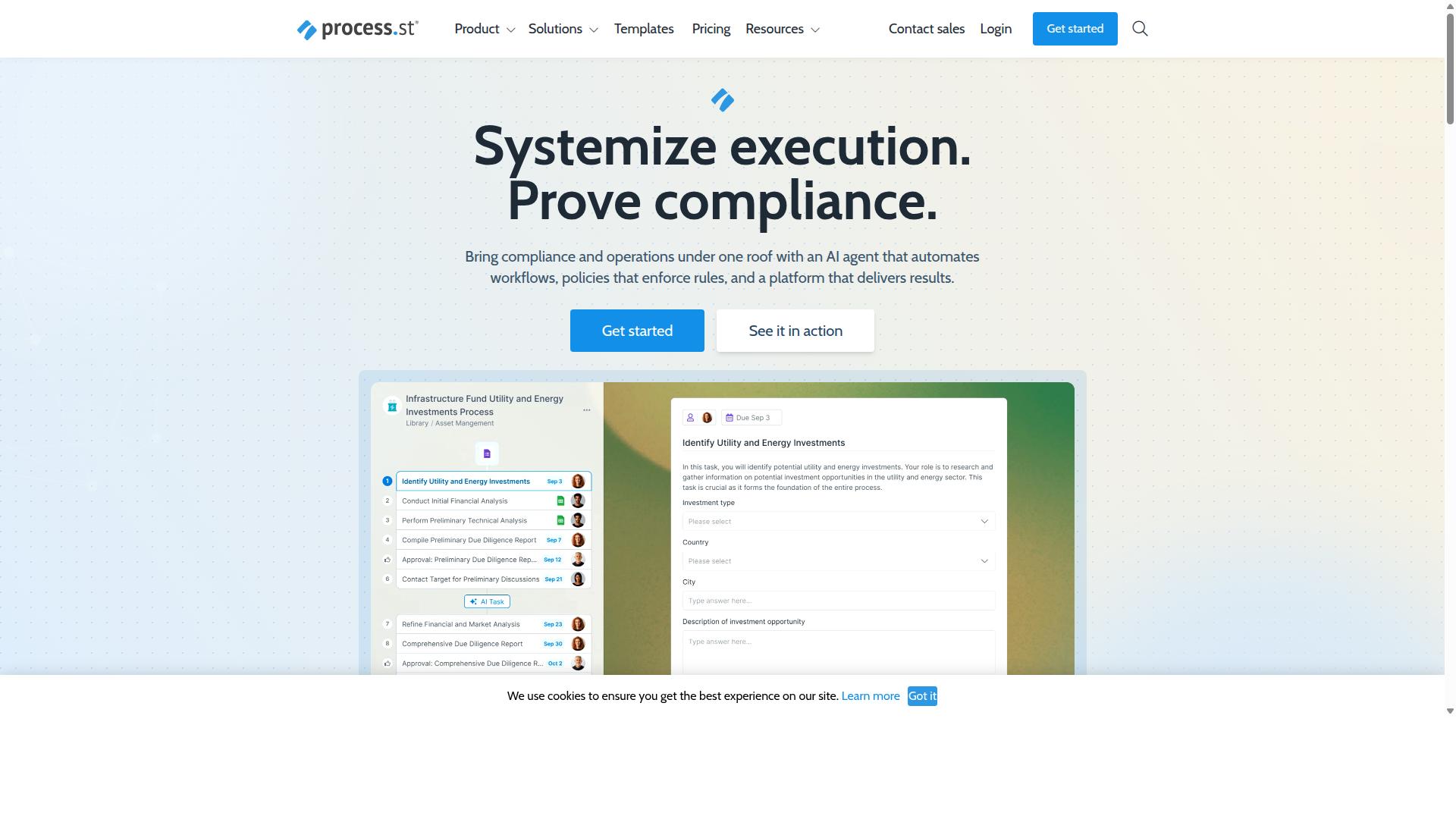
Process Street stands out as the top choice for organizations seeking comprehensive governance workflow automation with proven enterprise-scale deployment.
The platform serves 3,000+ companies and 1m+ users globally. 49k+ employees have standardized onboarding through the system across multiple industries.
SOC 2 Type II and ISO 27001 certifications provide the compliance credentials enterprise teams require for sensitive data handling and regulatory oversight.
Workflow Automation and Process Orchestration
Process Street converts policy documents into executable AI-powered workflows that orchestrate tasks across teams and systems automatically.
The Ops product turns policies into AI-powered workflows through the workflow designer. This interface supports conditional logic and parallel task execution for complex approval sequences.
Users report 30% faster documentation when building and maintaining process flows. The platform integrates with Zapier, Microsoft Power Automate, Tray.io, and Make for broader ecosystem connectivity.
Compliance and Policy Enforcement
Process Street's Docs product provides document management and policy control with full governance for ISO 9001, SOC 2, SOX, and FDA compliance frameworks.
Policy documents automatically trigger compliance workflows with mandatory task completion requirements. The system generates audit-ready proof for external auditors without manual compilation.
IMCD UK reported 75%+ reduction in setup time during implementation. This efficiency gain demonstrates the platform's ability to enforce policy requirements at enterprise scale.
AI-Powered Monitoring and Risk Management
Process Street continuously monitors workflow execution against defined policies, flagging deviations and generating risk scores in real-time.
The AI-powered monitoring identifies process bottlenecks and compliance gaps automatically through ongoing analysis. Cora, the AI compliance agent, monitors regulations and flags risks without constant manual oversight.
The reporting dashboard provides executive-level risk visibility with drill-down capabilities to individual task level. This structure supports both high-level oversight and detailed investigation needs.
2. Diligent
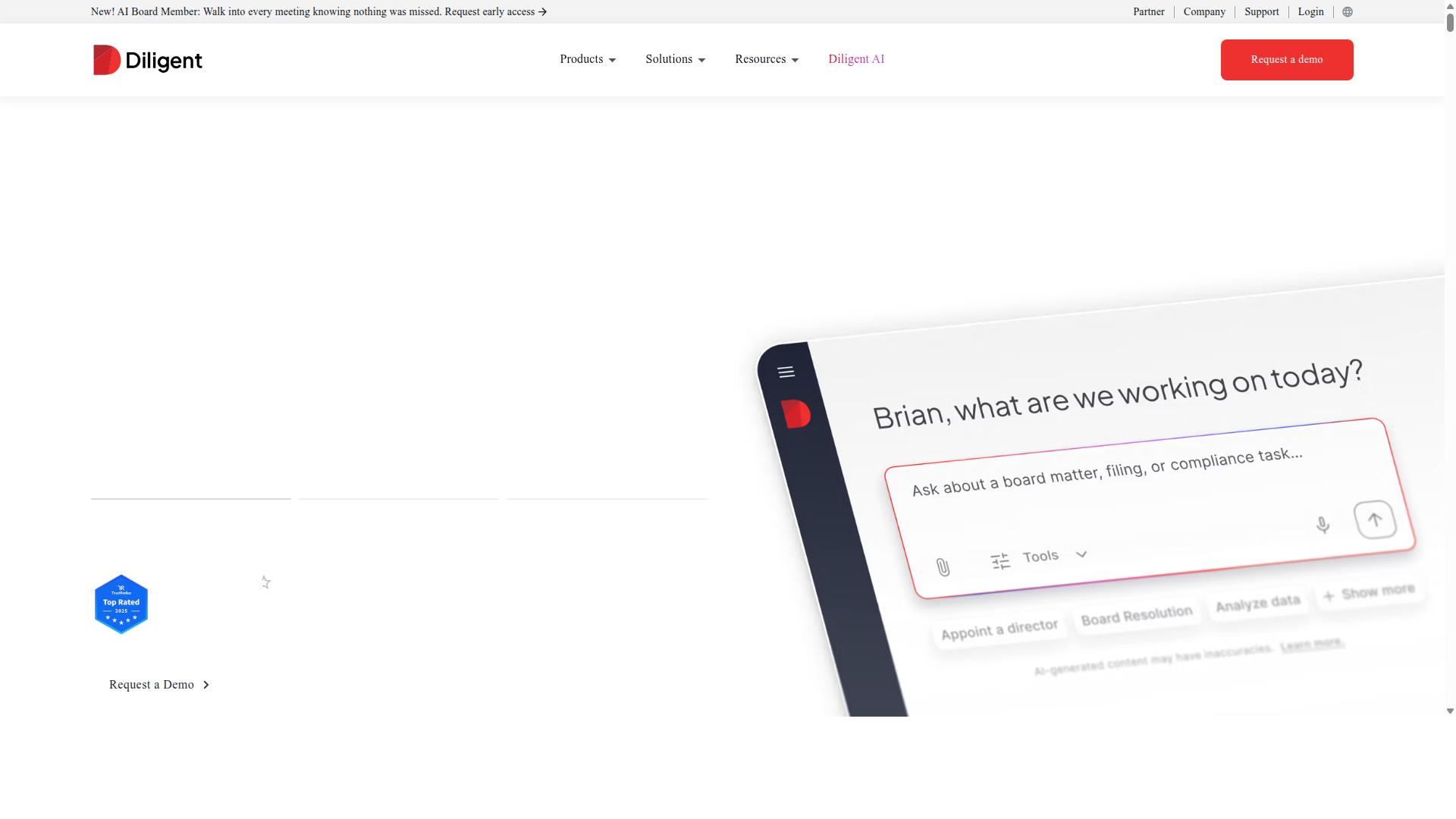
Diligent offers enterprise risk and governance solutions focused on board-level oversight and regulatory compliance management. Organizations across public companies, private firms, nonprofits, and government agencies use these platforms to maintain structured oversight of risk events and compliance obligations.
These solutions typically support workflow automation for governance tasks, helping teams coordinate policy reviews and approval workflows through defined sequences. The platforms serve roles including general counsel, risk managers, compliance officers, and internal auditors who need consistent documentation trails.
Enterprise Risk and Compliance Features
Diligent platforms generally provide centralized risk registers and automated compliance monitoring across organizational departments. These systems may include risk assessment frameworks that help identify potential threats before they impact operations or regulatory standing.
Compliance tracking features often provide real-time visibility into regulatory requirements and policy enforcement status. Organizations can monitor third-party relationships and track conflicts of interest through dedicated management modules that maintain audit trails for accountability purposes.
Internal controls and analytics capabilities support ongoing evaluation of governance effectiveness. Policy managers and compliance education tools help maintain consistent standards across different business units and geographic locations.
Board and Governance Reporting
Board reporting features in Diligent solutions typically aggregate governance metrics and risk indicators for executive stakeholder review. These capabilities help boards receive consistent information about organizational risk posture and compliance status.
Automated generation of governance scorecards enables regular assessment of performance against established benchmarks. Risk heat maps provide visual representations that help board members quickly understand priority areas requiring attention or additional resources.
Meeting preparation tools support secure distribution of materials and documentation. These features help maintain confidentiality while ensuring board members have access to current information needed for effective oversight and decision-making.
3. BIC Platform
BIC Platform focuses on business process modeling with integrated compliance capabilities for regulated industries. Enterprise organizations often evaluate this suite when seeking structured approaches to workflow automation and governance tools. The platform addresses both process orchestration needs and regulatory compliance requirements.
Many companies in automotive, finance, and healthcare sectors consider this type of integrated BPM and GRC solution. Organizations may benefit from having process modeling, execution, and compliance management within a single environment. This unified approach can reduce complexity when managing multiple governance frameworks.
Business Process Modeling and Automation
BIC Platform provides business process modeling tools that enable organizations to document and automate their operational workflows. The system generally offers BPMN notation support for creating standardized process diagrams. Teams can map current operations and identify opportunities for task automation.
Typical features include workflow designer capabilities that allow users to create approval workflows and policy enforcement mechanisms. The platform may provide no-code and low-code options for different technical skill levels. This flexibility can support both business users and technical teams in process automation efforts.
Process execution components often include document management and intelligent document processing features. Organizations can connect various systems through API integration capabilities. The process portal provides a centralized location for accessing workflows and governance tools across departments.
Regulatory Compliance Capabilities
Regulatory compliance features in BIC Platform generally include audit trail functionality and policy management controls. The GRC module often supports enterprise risk management, internal control systems, and ESG reporting requirements. Organizations in regulated industries may find these capabilities helpful for maintaining compliance documentation.
The platform may provide access management and security controls that align with industry standards. Change management processes can be documented and tracked through the system. Single sign-on integration helps maintain consistent security protocols across enterprise environments.
Reporting capabilities typically include analytics engines that support compliance monitoring and risk assessment activities. The system can assist with data governance requirements by tracking how information flows through processes. Organizations often use these features to demonstrate regulatory compliance during audits and assessments.
How to Choose the Right Option
Selection criteria should align with your organization's specific operational requirements, compliance obligations, and technical infrastructure constraints. Enterprise governance tools must address the distinct needs of operations, compliance, human resources, finance, IT and security teams across financial services, real estate, manufacturing, healthcare, professional services, and technology industries.
Start by mapping your current governance framework against available solutions. Identify which business processes require automation, such as employee onboarding, client onboarding, ISO compliance, quality tracking, and document control. This assessment helps narrow options to tools that support your existing workflows rather than requiring major process changes.
Next, evaluate each platform's ability to handle your scale and complexity. Consider how many users will access the system, how frequently processes run, and whether your operations span multiple departments or locations. The right solution grows with your governance needs without creating bottlenecks or requiring frequent reconfiguration.
Integration capabilities determine how effectively a governance tool connects with your existing enterprise software stack. Review API integration options, single sign-on support, and compatibility with systems already in use across your organization. Strong integration reduces manual data transfer and maintains consistency between platforms.
Compliance certification verification comes next in the evaluation sequence. Confirm that potential solutions hold relevant certifications for your industry and regulatory environment. This step ensures the platform meets security controls, data governance standards, and audit requirements specific to your sector.
Process Street supports enterprise governance through employee onboarding, client onboarding, ISO compliance, quality tracking, document control, and custom workflows. The platform serves operations, customer management, compliance, human resources, finance, IT and security teams across financial services, real estate, manufacturing, healthcare, professional services, technology, capital markets, and property management industries.
Document your findings in a structured comparison that includes scalability metrics, integration requirements, and certification status for each option under consideration. This approach creates a clear record for stakeholder review and helps justify the final selection based on objective criteria rather than vendor presentations alone.
Final Verdict
Process Street demonstrates the strongest combination of workflow automation depth and compliance governance capabilities for enterprise-scale deployments. Enterprise governance requires tools that handle both complex approval workflows and strict regulatory compliance simultaneously.
Organizations need platforms that reduce setup complexity while maintaining audit trails and policy enforcement standards. Research suggests that companies struggle most with documentation speed and initial configuration time when selecting governance tools.
Process Street delivers 30% faster documentation compared to manual processes. The platform also achieves 75%+ reduction in setup time as reported by IMCD UK, allowing teams to implement governance frameworks quickly without sacrificing security controls.
Security certifications matter for enterprise adoption. SOC 2 Type II certification and ISO 27001 certification provide documented evidence of rigorous security controls and data protection measures that satisfy regulatory requirements.
Support quality affects daily operations and problem resolution speed. Process Street maintains a 5 minutes average response time with a 98% customer rating, ensuring that governance teams receive prompt assistance when configuring complex approval workflows or troubleshooting integration issues.
Over 3,000 companies and 1 million users have selected Process Street for their workflow automation needs. The platform supports regulatory compliance through HIPAA compliance with BAA available upon request, along with GDPR and CCPA compliance standards.
Data privacy extends to AI usage policies. Data never gets used to train AI models, addressing enterprise concerns about information security when deploying workflow automation across sensitive business processes.
Process Street availability through AWS Marketplace streamlines procurement for organizations already operating within Amazon Web Services environments. This deployment option reduces vendor management overhead while maintaining existing security protocols.